Constitutional boundary

The constitutional foundation remains protected.

The immutable constitutional core of GCA is fully protected and is not subject to modification, limitation, replacement or abolition by any system, process, model, governance mechanism, validation method, accreditation mechanism or evolutionary/change mechanism. All development and research remains within fixed constitutional boundaries.

GCA

GLOBAL CONSTITUTIONAL
ARCHITECTURE

Beyond artificial intelligence.

GCA explores how increasingly capable intelligence can exist within fixed constitutional boundaries, remain accountable and aligned with legitimate human authority, and develop responsibly across different domains.

GCFRI RESEARCH INITIATIVE
Intelligence is advancing.
The question is not only
what it can do — but
how it should exist.
Public overview

Five foundations. One controlled architecture.

GCA combines constitutional protection, governance, evidence, independent review and controlled evolution. The detailed framework is organized into focused sections so the public homepage remains clear and concise.

GCA architectural systems

Complementary systems within GCA.

GCA works with complementary systems that support the development, coherence, documentation, evaluation and continuity of the architecture. Public descriptions remain intentionally high-level and do not disclose protected implementation or internal controls.

GSWMS

Global Standard Writing Management System

Provides normative and standards-management infrastructure for the development, verification, certification, governance and publication of standards and specifications within GCA. It operates within GCA's constitutional boundaries and does not establish fundamental constitutional principles.

GCF

Coordination & integration

Supports coordination and integration across relevant GCA activities and components while preserving coherence within the architecture. Public material does not define internal coordination mechanisms.

GCDS

GCA Documentation System

Provides constitutional knowledge and documentation infrastructure for registered information, documentation, traceability, evidence, knowledge continuity and lifecycle management within GCA. It preserves and supports established constitutional knowledge but does not create or alter fundamental constitutional principles.

FETA

Evaluation & feedback

Supports structured evaluation and feedback around relevant GCA development and research without disclosing protected internal mechanisms.

Constitutional derivation: The GCA Constitutional Foundation is the sole source of fundamental constitutional principles within the architecture. Supporting systems may specify, operationalize, document, evaluate or support those principles within their respective roles; they do not become an independent constitutional source.
Architectural boundary: these systems support GCA within their respective roles. They do not independently establish, modify, limit, replace or abolish the fundamental constitutional foundation of GCA.
Open collaboration within GCA

Different organizations. Defined responsibilities. One constitutional boundary.

GCFRI provides a framework through which organizations, researchers and other qualified participants can collaborate within GCA. Participation is based on clearly defined responsibilities, mutual accountability and equal standing within the applicable area of work.

GUARDIANS, developers and other participating organizations may contribute through distinct but equally responsible roles, each operating within the fixed constitutional boundaries of GCA.

No participating organization or role has authority to modify, limit, replace or abolish the immutable constitutional core.

GCA enables collaboration without requiring centralized ownership of every function: responsibilities may be distributed among independent participants while constitutional boundaries, accountability, traceability and role-specific responsibilities remain clearly defined.

GCA governance & controlled operations

GCA is operated through defined roles, controls and a controlled registry environment.

GCFRI provides the institutional context in which GCA can be researched, developed, governed and documented. The public website is the communication layer; the operational record is maintained through a controlled GCA registry/database environment with defined access, validation, governance and review responsibilities.

GCFRI's role

GCFRI provides institutional coordination and the framework through which qualified people and organizations can participate in GCA. GCFRI does not become an independent source of constitutional authority: the immutable constitutional core remains protected within the fixed boundaries of GCA.

  • maintaining the institutional framework and defined responsibilities;
  • supporting controlled operational processes and qualified participation;
  • supporting governance, assurance, documentation and review functions;
  • preserving separation between institutional administration and independent substantive review.

Controlled GCA registry/database

GCA does not treat an email, webpage, proposal or submission as automatically becoming part of the architecture. Relevant material enters a controlled process in which its provenance, status, integrity, authority and applicable review requirements can be assessed before formal acceptance or registration.

  • controlled intake and provenance;
  • role-based handling and access;
  • validation and integrity checks;
  • review and governance status;
  • traceable registry status and lifecycle management.
GATE 01

Submission

Receive material through an identified and controlled intake route.

GATE 02

Governance

Determine scope, authority, role, conflicts and applicable process.

GATE 03

Integrity

Check provenance, completeness, consistency and record integrity.

GATE 04

Assurance

Apply relevant validation, evidence and assurance requirements.

GATE 05

Independent review

Obtain substantive expert review where the record or decision requires it.

GATE 06

Status / registry

Assign the appropriate status and register only what is formally accepted.

Important: these public descriptions explain the operating principle, not protected technical security controls. Internal access mechanisms, protected implementation details and sensitive review procedures are not published on the public site.
Independent Review Panel charter

Independent review is designed to challenge, not simply endorse.

The public charter describes the role at a functional level. Individual reviewer records, screening evidence and protected review material remain controlled.

Purpose

Provide qualified, independent assessment of designated GCA research, architecture, claims or evidence.

Independence

Reviewers should be able to reach critical, neutral or supportive conclusions without being required to endorse GCA.

Expertise

Selection should collectively cover relevant scientific, technical, governance, legal, assurance and risk domains.

COI

Relevant conflicts of interest are identified and managed before independent participation.

Confidentiality

Protected review material may require a Confidentiality, Limited Use and Intellectual Property Agreement.

Authority boundary

Review participation does not itself grant governance, registry or constitutional authority.

Illustrative review outcomes: sufficient for stated purpose · clarification required · revision required · not supported by available evidence · further research required.
Independent scientific review panel

Qualified experts may be invited or may apply to be considered.

GCA is building a multidisciplinary review capability for substantive assessment of research, architecture, governance, assurance and other matters that require independent expertise. An invitation or self-application is not an appointment. Every prospective panel member is screened against the applicable eligibility, independence and integrity requirements before appointment.

Constitutional & governance expertise

Knowledge of constitutional design, institutional governance, authority boundaries, accountability, oversight and separation of powers or comparable governance structures.

Systems & architectural expertise

Demonstrated ability to analyse complex systems, system architecture, dependencies, interfaces, lifecycle design and failure modes across organizational or technical domains.

AI & advanced intelligence

Expertise in artificial intelligence, machine learning, agentic or autonomous systems, AI safety/alignment, or another relevant field of increasingly capable intelligent systems.

Verification, validation & assurance

Experience with evidence-based verification, validation, assurance, audit, testing, scientific review, standards or other methods for determining whether claims and requirements are adequately supported.

Security, resilience & risk

Relevant expertise in cybersecurity, information security, safety engineering, resilience, threat/risk assessment, critical systems or comparable protection disciplines where applicable.

Law, ethics & human responsibility

Relevant expertise in law, ethics, human rights, responsible technology, public policy or institutional responsibility, particularly where authority, rights and consequences intersect.

Scientific methodology & evidence

Strong competence in research methodology, evidence evaluation, uncertainty, reproducibility, peer review, source criticism and distinguishing established findings from hypotheses or proposals.

Standards, documentation & registry practice

Experience with standards, specifications, controlled documentation, provenance, configuration/change management, records, registries or other traceable knowledge systems.

Independence & professional judgment

Ability to provide candid, evidence-based conclusions without allowing organizational, commercial, personal or ideological interests to override independent professional judgment.

Minimum expertise standard

A candidate does not need to be an expert in every listed field. GCA requires demonstrable professional, academic, scientific or equivalent expertise in at least one relevant primary domain , together with the ability to conduct multidisciplinary review and understand the constitutional, governance, evidence and independence requirements applicable to the assignment. The panel as a whole must collectively provide sufficient coverage of the core domains required for the matters under review. Appointment therefore depends on both individual competence and the expertise balance required by the panel.

What GCA looks for in prospective panel members

Relevant qualifications or a demonstrable professional/academic record; substantial subject-matter competence; clear analytical and written-review ability; evidence-based reasoning; professional integrity; independence of judgment; willingness to declare and manage conflicts of interest; respect for constitutional boundaries; and the ability to handle non-public information responsibly. GCA may consider senior researchers, academics, engineers, architects, lawyers, governance specialists, security professionals, scientists, standards experts and other specialists whose expertise is relevant to the review mandate.

01 · ACCESS

Invitation or self-application

Qualified people may be invited or may submit themselves for consideration.

02 · SCREENING

Eligibility review

Credentials, experience, relevance and professional standing are assessed.

03 · INDEPENDENCE

COI assessment

Conflicts, competing interests and independence are reviewed and documented.

04 · DUE DILIGENCE

Integrity checks

Appropriate checks may be performed before any appointment is made.

05 · AGREEMENT

Protected participation

Required confidentiality, limited-use and IP obligations must be accepted in writing.

06 · APPOINTMENT

Formal designation

Only approved candidates are designated for the applicable review role.

Confidentiality, Limited Use and Intellectual Property Agreement

Before receiving protected or non-public GCA review material, a selected panel member must sign the applicable Confidentiality, Limited Use and Intellectual Property Agreement . The agreement is intended to establish clear obligations concerning confidentiality, permitted use of information, protection of non-public material, handling of intellectual property and related responsibilities. Signing the agreement is a condition of protected panel participation where the applicable review work involves non-public information.

Independence is part of the review function

The review panel is not a promotional body and does not exist to endorse GCA. Its purpose is to provide qualified, critical and independent assessment. Panel members may identify weaknesses, uncertainty, missing evidence, governance concerns, constitutional boundary issues or reasons why a proposal should not be accepted in its submitted form. GCFRI administration and panel review are therefore treated as distinct functions, subject to the applicable governance framework.

Independent Reviewer Inquiry

Submit an expression of interest for consideration.

This form creates an inquiry for administrative consideration. It does not create an appointment, panel membership, accreditation, registry entry or authority within GCA. Any later designation remains subject to the published screening, independence, COI, due-diligence, agreement and appointment pathway.

Public intake boundary: please provide only information appropriate for an initial inquiry. Do not submit confidential GCA material, trade secrets, protected research, security-sensitive information, personal identification documents or other non-public material through this public form. Additional information may be requested through a controlled route if appropriate.
Submission method: selecting the button prepares an email to GCFRI at info@gcfri.org. Your email client may ask you to confirm the message before it is sent. No server-side registry entry is created by this webpage.
Public governance map

Responsibilities are separated at the public institutional level.

The map below explains the intended separation of functions without publishing internal authority matrices, credentials, security controls or private decision procedures.

GCFRI Institutional context & coordination Does not automatically possess authority to alter the immutable constitutional core.
GCA GOVERNANCE Policy, authority & lifecycle responsibility Operates within the constitutional boundaries.
REGISTRY / OPERATIONS Controlled records & lifecycle administration Does not turn a submission into an accepted record by default.
ASSURANCE Evidence, integrity & verification Does not substitute for independent scientific judgment.
REVIEW PANEL Independent scientific & expert challenge Does not automatically govern, administer or amend GCA.
PUBLIC Access to designated public information Public communication does not expose protected implementation details.
GCA future path · five-year vision

From constitutional foundation to institutional maturity.

GCA is intended to develop progressively. The five-year view describes a target level of maturity rather than a promise of completed deployment. Each stage depends on evidence, governance readiness, independent review and the ability to demonstrate that the preceding stage has been achieved.

2026–2027 · FOUNDATION

Build the foundations

  • constitutional framework and boundaries
  • governance roles and responsibilities
  • controlled registry/database foundation
  • review and assurance framework
  • formal participation requirements
2027–2028 · VALIDATION

Test and challenge

  • controlled research and review cycles
  • evidence and assurance development
  • independent expert assessment
  • governance and process testing
  • identification and correction of weaknesses
2028–2029 · INTEGRATION

Connect the architecture

  • coherent interaction among GCA functions
  • stronger documentation and traceability
  • mature registry and lifecycle practices
  • multidisciplinary research coordination
  • continued independent challenge
2029–2030 · INSTITUTIONALIZATION

Demonstrate maturity

  • stable governance and role separation
  • repeatable review and assurance processes
  • established evidence and documentation practice
  • qualified external participation
  • clear public/protected information boundaries
2030–2031 · MATURITY

Assess broader readiness

  • independent assessment of maturity
  • demonstrable institutional coherence
  • credible body of reviewed research
  • potential wider scientific/institutional engagement
  • decision on the next stage based on evidence
Evidence-dependent progression: reaching a calendar year does not automatically advance GCA to the next stage. A stage is considered mature only when its applicable requirements, evidence, governance conditions and independent review expectations have been sufficiently met. If they have not, GCA remains at the relevant maturity level until the deficiencies are addressed.
GCA maturity framework

Progress is measured by capability and evidence, not by time.

The maturity levels provide a public conceptual model for understanding where GCA stands. They do not disclose protected implementation controls and do not constitute a claim that any future level has already been achieved.

LEVEL 0

Concept

Research questions, concepts and initial architectural formulation.

LEVEL 1

Foundation

Constitutional, governance, registry and participation foundations are defined.

LEVEL 2

Controlled Development

Defined processes and roles can be applied and tested in controlled development.

LEVEL 3

Independently Reviewed

Relevant claims or components have undergone appropriate independent assessment.

LEVEL 4

Institutional Maturity

Governance, review, assurance, registry and documentation operate coherently.

LEVEL 5

External Readiness

Sufficient evidence and maturity exist to consider broader external engagement.

What success means for GCA

Success is not defined by universal adoption or by presenting GCA as a finished solution. A stronger success condition is that the architecture becomes sufficiently mature, transparent in its public claims, traceable in its development, independently challengeable and institutionally governed that qualified external experts can critically evaluate it without having to rely solely on the assertions of its creators.

Future boundary: this roadmap describes intended direction and maturity objectives. It does not disclose confidential architecture, internal security mechanisms, protected research, private registry information or future decisions that have not yet been formally made. It also does not guarantee that every proposed application, system or milestone will ultimately be implemented.
Public by design

Protected by principle.

Public materials describe GCA at an appropriate level of abstraction. Protected architectural details, internal controls, implementation mechanisms and other non-public information are intentionally excluded from the public presentation.

What the public site communicates

  • Purpose, research direction and public questions
  • High-level roles of complementary systems
  • Public collaboration pathways and responsibilities
  • Clear distinctions between established descriptions and research-stage material
GSWMS · Public presentation layer

Clear claims. Visible limits. Traceable reasoning.

GCA uses GSWMS as normative and standards-management infrastructure, while its public presentation layer applies a disciplined research-writing approach: each block has one primary function, observations are distinguished from interpretation, and material claims are presented with their relevant limitations. GSWMS specifies and operationalizes applicable standards within GCA; it is not a source of fundamental constitutional principles.

ST · STRUCTURE

One function at a time

Each section answers one identifiable question instead of combining unrelated purposes.

MT · METHOD

Observation before interpretation

What is being described is separated from what is inferred, proposed or explored.

TL · LANGUAGE

Precise terminology

Terms such as architecture, research, authority, governance and verification are used consistently.

CS · CONSISTENCY

Stable framing

Public claims, section headings and calls to action use the same research framing throughout the page.

EV · EVIDENCE

Limits remain visible

Potential relevance is not presented as a completed result; uncertainty and scope are stated where material.

Public boundary: this standard improves the clarity and traceability of public communication. It does not publish confidential GCA architecture, protected implementation details or internal research controls.
Constitutional boundary

The immutable constitutional core of GCA is fully protected and is not subject to modification, limitation, replacement or abolition by any system, process, model, governance mechanism, validation method, accreditation mechanism or evolutionary/change mechanism. All development and research remains within fixed constitutional boundaries.

GCA architectural systems

GCA works with complementary systems that support the development, coherence, documentation, evaluation and continuity of the architecture.

GSWMS

Global Standard Writing Management System

Provides normative and standards-management infrastructure for the development, verification, certification, governance and publication of standards and specifications within GCA. It operates within GCA's constitutional boundaries and does not establish fundamental constitutional principles.

GCF

Global Coordination Framework

Supports coordination and integration across relevant GCA components, knowledge and activities while preserving architectural coherence.

GCDS

GCA Documentation System

Constitutional knowledge and documentation infrastructure for registered information, documentation, traceability, evidence, knowledge continuity and lifecycle management within GCA.

FETA

Evaluation & Feedback

Supports structured evaluation and feedback concerning relevant developments and findings within the public boundaries of GCA.

System relationship: these systems operate within the constitutional boundaries of GCA. They support the architecture but do not independently establish, modify, limit, replace or abolish its fundamental constitutional foundation.
Complementary GCA infrastructure

GSWMS determines and manages the applicable standards and normative requirements for work within GCA. GCDS maintains the registered information, documents, relationships, evidence and knowledge continuity associated with that work. They are complementary infrastructures with distinct responsibilities.

Constitutional derivation: The GCA Constitutional Foundation is the sole source of fundamental constitutional principles within the architecture. GSWMS and GCDS may specify, operationalize, document or support those principles, but neither independently establishes, modifies, limits, replaces or abolishes them.

Open collaboration within GCA

GCFRI provides a framework through which organizations, researchers and other qualified participants can collaborate within GCA. Participation is based on clearly defined responsibilities, mutual accountability and equal standing within the applicable area of work. GUARDIANS, developers and other participating organizations may contribute through distinct but equally responsible roles, each operating within the fixed constitutional boundaries of GCA. No participating organization or role has authority to modify, limit, replace or abolish the immutable constitutional core.

GCA enables collaboration without requiring centralized ownership of every function: responsibilities may be distributed among independent participants while constitutional boundaries, accountability, traceability and role-specific responsibilities remain clearly defined.

Interested in GCA?

Organizations, researchers, developers and other qualified participants are welcome to contact GCFRI to explore appropriate ways to engage, collaborate or contribute within the public boundaries of GCA.

Public claim status

Know what a statement represents.

Public GCA material distinguishes between what is established in the public record, what is being researched, what is proposed and what represents possible future relevance.

Established description

A public description supported by the available GCA record.

Research question

A question or area under investigation, not a completed result.

Proposal

A proposed direction or concept that is not presented as established architecture.

Potential relevance

A possible future application or significance, not a guarantee or completed product.

Current development status

GCA is in a foundation and controlled-development phase.

This status view distinguishes what has been established within the project from capabilities that are still being formalized, tested or independently assessed. The passage of time does not by itself advance a component to a higher status.

Constitutional Foundation Core public principles and protective boundaries have been developed.
FOUNDATION
Governance Framework Roles, responsibilities and authority boundaries are being progressively formalized.
UNDER DEVELOPMENT
Controlled Registry The registry function is being developed; operational evidence must be established without inventing historical records.
UNDER DEVELOPMENT
Independent Review Panel Candidate criteria, screening, independence, COI and agreement pathways are defined; no unmade appointment is implied.
FRAMEWORK ESTABLISHED
External Validation Independent external validation is not represented as completed unless evidence exists.
NOT YET COMPLETED
Commercial Deployment No public claim of mature commercial deployment is made by this website.
NOT ESTABLISHED
Public status rule: a description on this website is not evidence that a capability is operational, independently validated or commercially deployed. Where evidence is incomplete, the status is stated as such.
Public disclosure boundary

The information presented here describes GCA at a public institutional level. It does not constitute disclosure of confidential know-how, protected intellectual property, internal security architecture, private registry information or non-public operational procedures. Public descriptions are intentionally limited to information designated for public communication.

GCA transparency framework

Clear about what GCA is, how it works, and where its boundaries are.

GCA is intended to be understandable to the public without requiring access to protected institutional records. The public framework explains purpose, responsibilities, decision pathways, information classification, independent review and the limits of what GCA claims. Sensitive implementation details remain controlled where disclosure could compromise security, privacy, intellectual property, research integrity or institutional operations.

01

What GCA is

Global Constitutional Architecture is a research and institutional architecture for constitutional boundaries, governance, assurance and independent review around increasingly capable intelligence and complex future systems.

GCA is not itself an AI system, autonomous agent or ordinary software product. It provides an architectural framework within which relevant research, systems and development can be examined and governed.

02

Why GCA exists

GCA investigates whether durable constitutional boundaries, defined responsibilities, evidence requirements and independent challenge can improve the governance of increasingly capable technologies and complex future systems.

  • constitutional protection;
  • clear governance;
  • traceable evidence;
  • independent review;
  • controlled evolution.
03

How GCA works

At public level, GCA can be understood through the following illustrative lifecycle. It describes institutional functions, not the complete internal implementation:

Research / Proposal → Submission → Governance & Integrity Assessment → Evidence / Assurance → Independent Review → Governance Decision → Registry Status → Controlled Development / Publication
Illustrative public lifecycle — not a disclosure of internal implementation procedures.

Submission does not automatically mean acceptance.

04

Who is responsible

GCA separates functions so that no single role is intended to control the entire lifecycle.

  • GCFRI: institutional context and coordination;
  • GCA Governance: authority, policy and lifecycle responsibility;
  • Registry / Operations: controlled institutional records;
  • Assurance: evidence, integrity and verification;
  • Independent Review Panel: scientific and expert challenge;
  • Public: access to designated public information and outcomes.
05

What is public and protected

Public information explains GCA's purpose, principles, governance, research and development direction. Controlled and protected information is restricted only where there is a legitimate reason such as security, privacy, intellectual property, confidentiality or institutional integrity.

Protection is not intended to conceal criticism or unfavorable findings.

06

What GCA does not claim

  • GCA does not guarantee the behavior of future AI systems.
  • GCA does not claim that governance can eliminate all technological risk.
  • A GCA review is not automatically universal scientific truth.
  • Participation does not automatically constitute endorsement.
  • Registry inclusion does not automatically mean approval.
  • Future milestones are objectives, not guarantees.
  • GCA has no authority over external organizations unless explicitly and lawfully established.

GCA protection principles

01 · Separation of duties

Responsibilities are separated where appropriate to reduce concentration of authority.

02 · Controlled access

Not all institutional information is public by default.

03 · Provenance

Relevant records should remain traceable to their source and status.

04 · Independent review

Designated material can be critically examined by appropriately independent experts.

05 · Conflict-of-interest controls

Relevant interests are identified and managed before independent participation.

06 · Confidentiality

Protected information may be subject to defined confidentiality and limited-use obligations.

07 · Status discipline

Research, proposal, established information and approval are not treated as interchangeable.

08 · Constitutional protection

Operational development remains bounded by the immutable constitutional core.

09 · Auditability

Where appropriate, decisions and material changes should be reconstructable from controlled records.

10 · Public accountability

Public statements should correspond to the actual development and evidence status.

Protection principle: GCA seeks to protect legitimate security, privacy, intellectual-property, confidentiality and research-integrity interests without using information classification as a substitute for accountability. Where appropriate, public conclusions may be communicated without exposing the protected implementation details that produced them.
Immutable constitutional core

Development may evolve. The constitutional boundaries do not.

The GCA Constitutional Foundation establishes fundamental boundaries within which governance, systems, processes, research and future development must operate. No operational system, governance mechanism, accreditation process, validation method, research result or future technical development is intended to possess authority to modify, replace, restrict or abolish the immutable constitutional core.

Independent scientific review

Review is intended to challenge GCA, not simply endorse it.

Reviewers may reach conclusions that are critical of, neutral toward or supportive of the material under review. Review participation does not itself grant authority over GCA governance, registry administration or constitutional modification.

Expertise → Screening → Independence / COI → Due Diligence → Agreement → Appointment → Independent Assessment
Public information & protected architecture

Transparent about purpose. Deliberate about protected information.

GCA distinguishes between information intended for public understanding and information that belongs in controlled institutional records. This allows the architecture to remain transparent about its purpose, principles, governance and development while protecting sensitive implementation, research and registry information.

PUBLIC

Public information

Information published to explain GCA and GCFRI, their purpose, publicly established principles, governance approach and development direction.

  • mission and public purpose;
  • constitutional principles at public level;
  • governance roles and institutional responsibilities;
  • independent review framework;
  • research areas and public findings;
  • future path and maturity objectives.
CONTROLLED

Controlled institutional information

Information that may be necessary for GCA operations, review or governance but is not automatically designated for public release.

  • controlled registry records;
  • review dossiers and supporting evidence;
  • candidate and reviewer information;
  • non-public research material;
  • internal governance documentation;
  • restricted project records and provenance details.
PROTECTED

Protected information

Information whose disclosure could compromise security, confidentiality, intellectual property, individual privacy or the integrity of controlled operations.

  • security architecture and sensitive controls;
  • credentials or authentication information;
  • confidential intellectual property;
  • sensitive registry information;
  • protected technical implementation details;
  • information restricted by agreement or applicable law.
Disclosure principle: public availability is a deliberate designation, not the default status of every GCA record. Internal identifiers, canonical record references and protected implementation details are maintained in the appropriate controlled environment unless specifically designated for public release.
Public decision records

Public accountability without exposing protected records.

Where a decision has public significance, GCA may publish a public-facing decision record that states the subject, status, decision, basis and relevant public rationale while withholding protected implementation details where necessary.

SUBJECT Publicly named matter
STATUS Established / Under Review / Revised / Closed
DECISION Publicly releasable outcome
BASIS Summary of relevant evidence or process
PUBLIC RATIONALE Why the decision matters
PROTECTED MATERIAL Not disclosed where legitimate protection applies
Corrections & amendments

Public communication should be correctable without rewriting history.

GCA distinguishes between correcting public communication and altering canonical institutional records. Material public corrections should be identifiable by date and nature, while underlying controlled records retain appropriate provenance.

Editorial correction

Spelling, formatting or presentation issue without substantive change.

Substantive correction

A factual or interpretive public statement required correction.

Amendment

A public position or description has legitimately changed and the change is identified.

Historical provenance

Earlier records are not silently rewritten merely to make the current website appear historically unchanged.

Public claim & disclosure policy

Every public statement should have a clear status.

GCA public communication distinguishes established information from research, proposals and possible future relevance, so development concepts and future objectives are not mistaken for validated operational facts.

01 · STATUS

Classify the statement

Identify whether information is an established public description, research question, proposal or potential future relevance.

02 · DISCLOSURE

Check the audience

Determine whether information is public, controlled or protected before publishing it outside the appropriate institutional environment.

03 · PROVENANCE

Maintain the source

Retain the canonical internal record and provenance where appropriate, even when the public presentation uses a general descriptive name.

04 · VALIDATION

Do not overstate

Do not describe research, planned capabilities or future milestones as completed or independently validated unless the relevant evidence exists.

Identifier policy: canonical internal identifiers may remain part of GCA's controlled records and provenance system without being displayed on the public website. Public pages use descriptive names such as GCA Constitutional Foundation and Immutable Constitutional Core where that communicates the relevant concept without exposing internal record structure.
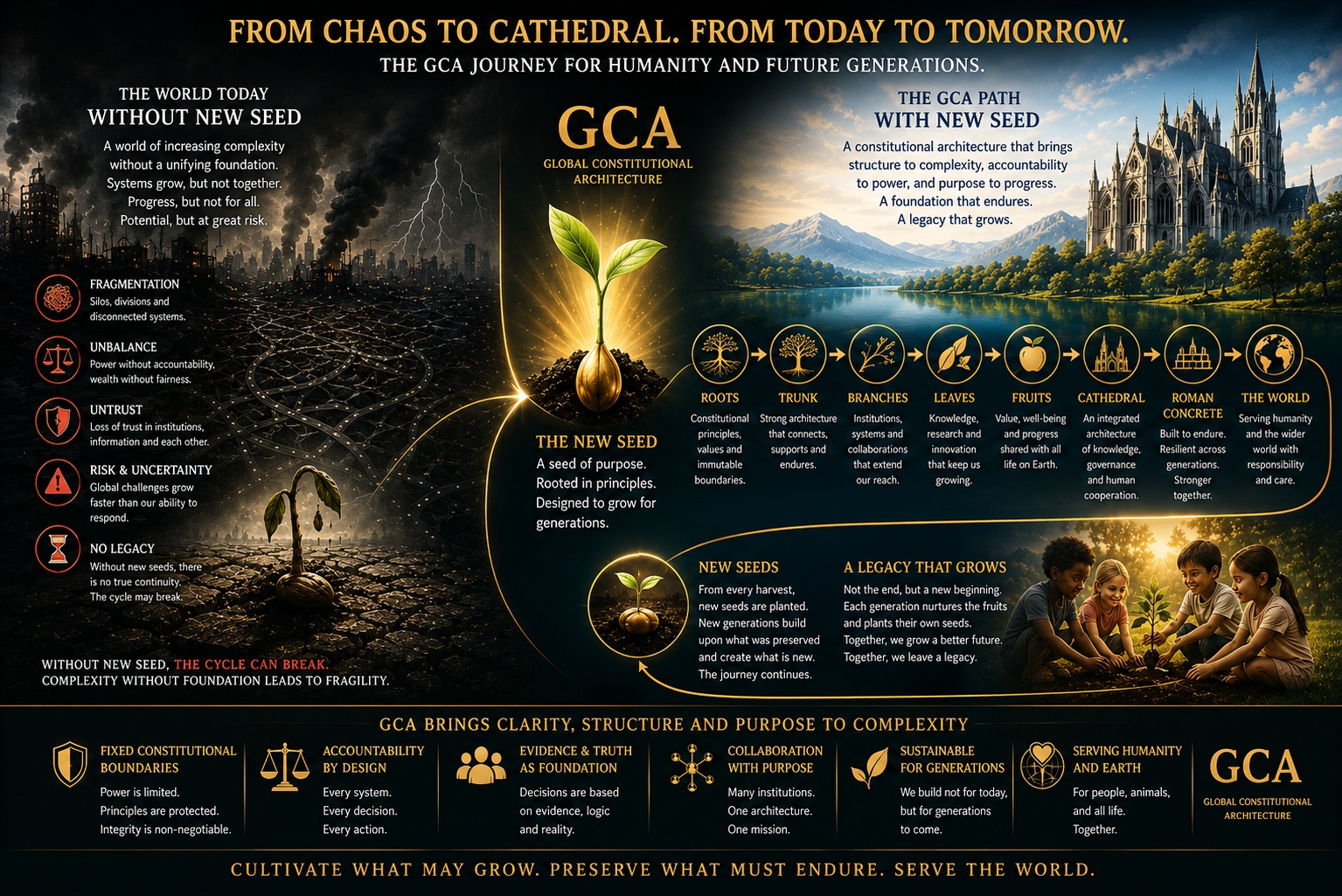
The GCA journey from a fragmented world without a new seed toward a constitutional architecture serving humanity and future generations

Our Mission

The mission of the Global Constitutional Architecture (GCA) is to cultivate an enduring architecture for knowledge, governance and human cooperation — beginning with a seed of purpose, emerging as a living foundation, taking root in enduring principles, and growing into a coherent architecture through which knowledge, institutions and human endeavour can develop.

From roots to trunk, from trunk to branches, from branches to leaves, and from leaves to fruit, GCA is designed to enable knowledge and human cooperation to grow, mature and produce lasting value. These developments may ultimately come together as a cathedral of knowledge, governance and shared human endeavour — built upon foundations intended to endure across generations, with the resilience and permanence symbolised by Roman concrete.

GCA seeks quality before speed, sustainability before perfection, and the quality of relationships before the mere expansion of networks. It seeks to enable increasing complexity without losing coherence, growth without losing identity, and progress without sacrificing the principles upon which the architecture was founded.

Its purpose is ultimately to serve humanity and the wider world: to preserve what must endure, cultivate what may grow, and return every harvest to the soil from which new seeds of knowledge, possibility and cooperation may emerge for generations yet to come.

CONSTITUTIONAL SAFEGUARD

Growth may expand the architecture. It may not alter its foundation.

Nothing in this Mission Statement, its metaphors, principles, architecture, governance mechanisms, developmental processes or future evolution shall be interpreted as granting any person, institution, system, process, model or authority the power to modify, replace, restrict, suspend, circumvent or abolish the immutable constitutional core of GCA.

Growth may expand the architecture; complexity may develop the architecture; generations may build upon the architecture — but no development may alter the constitutional foundation that defines and protects it.

The seed may become a tree, the tree may become a cathedral, and the cathedral may serve the world; yet the integrity of the foundation from which it grew remains constitutionally protected.

Cultivate what may grow. Preserve what must endure. Serve the world.

This visual expresses the mission and architectural philosophy of GCA. It does not amend, replace, interpret or supersede the GCA Constitution or its immutable constitutional core.

The opportunity

Capability is advancing. The architectural question is how increasingly capable intelligence should exist and be governed.

GCA explores how increasingly capable intelligence can be developed and used within fixed constitutional boundaries, clear accountability and legitimate human authority across different domains.

CAPABILITY Increasingly capable intelligent systems.
AUTHORITY Capability does not automatically create legitimate authority.
ARCHITECTURE GCA explores the constitutional layer between the two.
For investors and strategic partners

A long-term research opportunity.

GCA is being developed as a research and architecture initiative rather than as a claim that a finished solution already exists. Public materials focus on the problem space, direction, principles and potential significance.

The goal is to make the evolution observable while protecting what should remain protected.
Potential future relevance

Where could GCA matter?

These are public research areas and possible future relevance. They are not evidence that GCA has already solved these challenges.

Artificial Intelligence

Responsible AI, advanced systems, agentic systems and governance questions.

Autonomous Systems

Systems acting in the physical or digital world within defined boundaries.

Cybersecurity

Authorization, verification, trust and accountable operation.

Critical Infrastructure

Reliability and accountability where intelligent decision-support matters.

Scientific Research

Evidence-oriented coordination and long-horizon knowledge development.

Governance

Decision environments involving competing priorities and consequences.

Global Coordination

Problems that cross systems, institutions and jurisdictions.

Future Generations

Long-term consequences of decisions made today.

These represent public research areas and possible future relevance, not completed products or guarantees.
External validation & standardisation

Exploring the path from research to independent evaluation.

GCA is preparing for exploratory dialogue with relevant governance and standards stakeholders, including a potential engagement pathway with NEN and ISO/TC 309. No ISO endorsement or recognition is claimed.

EXPLORE THE PATHWAY →
Public GCA brief

A concise introduction to GCA.

A public, non-sensitive briefing covering the purpose, central question, research areas, principles, potential relevance and ways to engage.

Public edition · No confidential architectural information

Research

Public research can examine questions around capable intelligence, accountability, boundaries, evidence, governance and long-term impact.

Research Approach

The public-facing site describes research themes and questions without publishing confidential architectural details.

Public Scope

This material is intentionally general and does not disclose sensitive GCA architecture, internal controls or protected research details.

Public claim boundary

Public material distinguishes established descriptions from research questions, proposals and potential applications. Where a public page does not provide evidence for a conclusion, the conclusion is not presented as established fact.

About GCFRI

Global Collective Future Research Initiative (GCFRI) provides the public research context and collaboration framework through which GCA can be researched, documented and developed with defined responsibilities while remaining within its fixed constitutional boundaries.

About GCA

Global Constitutional Architecture explores how increasingly capable intelligence can remain accountable, bounded and aligned with legitimate human authority.

Public Information

The public site communicates high-level research themes, roles and engagement pathways while intentionally excluding sensitive implementation information.

Publications

This area can contain public papers, research notes, concepts and other non-sensitive material.

Research Notes

Future publications can be organized by research area and publication date.

Responsible Disclosure

Material that should not be public is intentionally excluded from this public presentation.

New publication

Strategic Opportunity

A public strategic brief describing the potential significance of GCA and its pathway toward external examination and standards dialogue.

READ STRATEGIC OPPORTUNITY →

Contact GCFRI

For investors, partners, organizations, researchers and public inquiries.

Artificial Intelligence

Public exploration of responsible AI, advanced AI systems, agentic systems and governance questions.

Robotics & Autonomous Systems

Public exploration of systems that operate in the real world while remaining within defined boundaries.

Scientific Research

Public exploration of research coordination, evidence evaluation and long-horizon knowledge development.

Cybersecurity

Public exploration of authorization, verification and trust in increasingly capable systems.

Critical Infrastructure

Public exploration of reliability, accountability and verification in critical environments.

Governance & Oversight

Public exploration of decision-support, competing priorities, oversight and human responsibility.

Global Coordination

Public exploration of problems that cross institutions, systems and jurisdictions.

Long-Term Impact & Future Generations

Public exploration of how decisions made today may affect humanity and future generations.